Characterization of Molecular Beacons
Table of contents
1. Characterization of molecular beacons
1.1. Signal to background ratio
- Determine the fluorescence of 200 µl of molecular beacon buffer solution (Fbuffer), using 491 nm as the excitation wavelength and 515 as the emission wavelength.
If the fluorophore is not fluorescein, choose wavelengths that are optimal for the fluorophore in the molecular beacon.
- Add 10 µl of 1 µM molecular beacon to this solution and record the new level of fluorescence (Fclosed).
- Add a two-fold molar excess of a complementary oligonucleotide target and monitor the rise in fluorescence until it reaches a stable level (Fopen).
- Calculate the signal-to-background ratio as (Fopen-Fbuffer)/(Fclosed-Fbuffer).
1.2. Thermal denaturation profiles
- Prepare two tubes containing 50 µl of 200 nM molecular beacon dissolved in 3.5 mM MgCl2 and 10 mM Tris-HCl, pH 8.0 and add the oligonucleotide target to one of the tubes at a final concentration of 400 nM.
- Determine the fluorescence of each solution as a function of temperature using a spectrofluorometric thermal cycler. Decrease the temperature of these tubes from 80 °C to 10 °C in 1 °C steps, with each hold lasting one minute, while monitoring the fluorescence during each hold.
1.3. Results
An example of a hybridization reaction performed for the determination of the signal-to-background ratio is shown in Figure 1. The signal-to-background ratio in this example was 190. Usually the ratio ranges from 30 to 200. An example of a thermal denaturation profile is shown in Figure 2. The probe-target hybrid denatures at 58 °C and the stem of the molecular beacon denatures at 64 °C. In the range of 10 °C to 50 °C, the free probe has very little fluorescence, whereas the target-bound form is fluorescent. The sequence of the molecular beacon used throughout this section is: fluorescein-5'- GCG AGC TAG GAA ACA CCA AAG ATG ATA TTT GCT CGC -3'-dabcyl, where underlines identify the arm sequences.
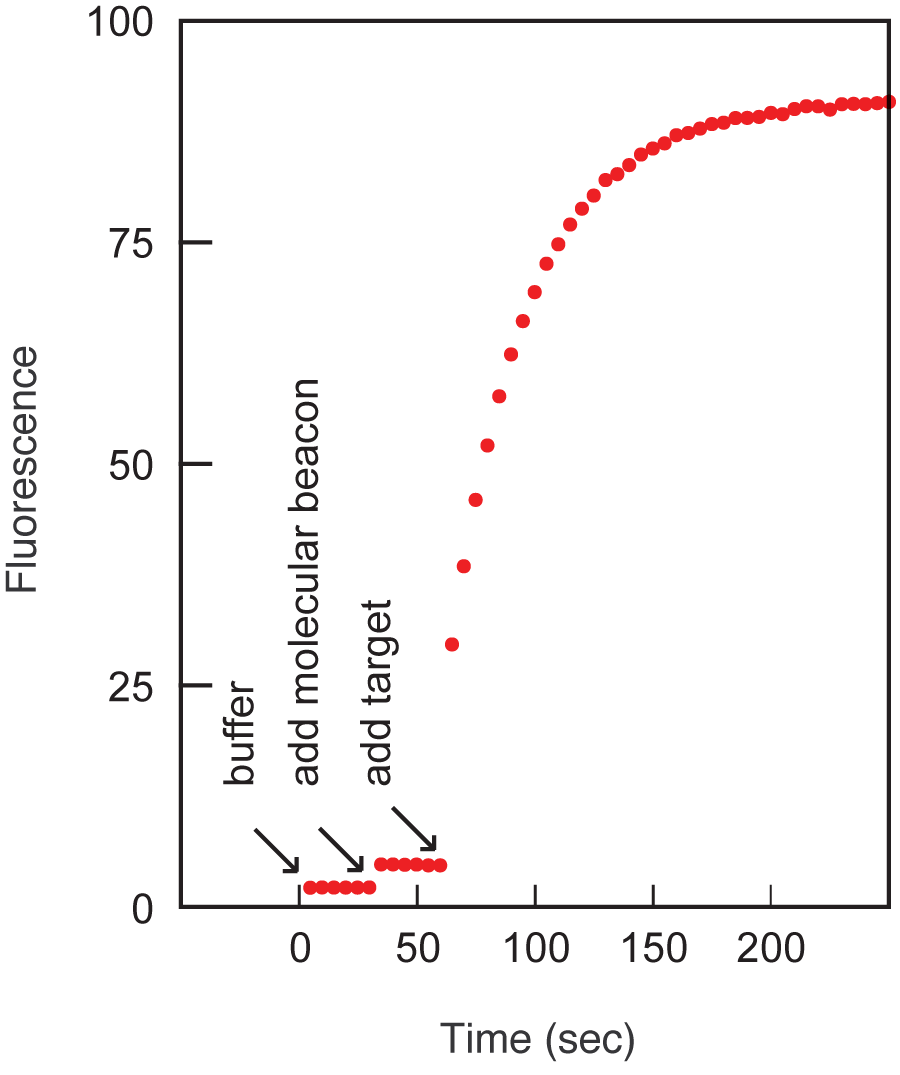
Figure 1. The spontaneous fluorogenic response of molecular beacons to the addition of target. The first segment of the data is due to the fluorescence of the buffer, the second segment is due to the fluorescence of the buffer containing the molecular beacons, and the third segment shows the increase in fluorescence that occurs upon the addition of target oligonucleotides.
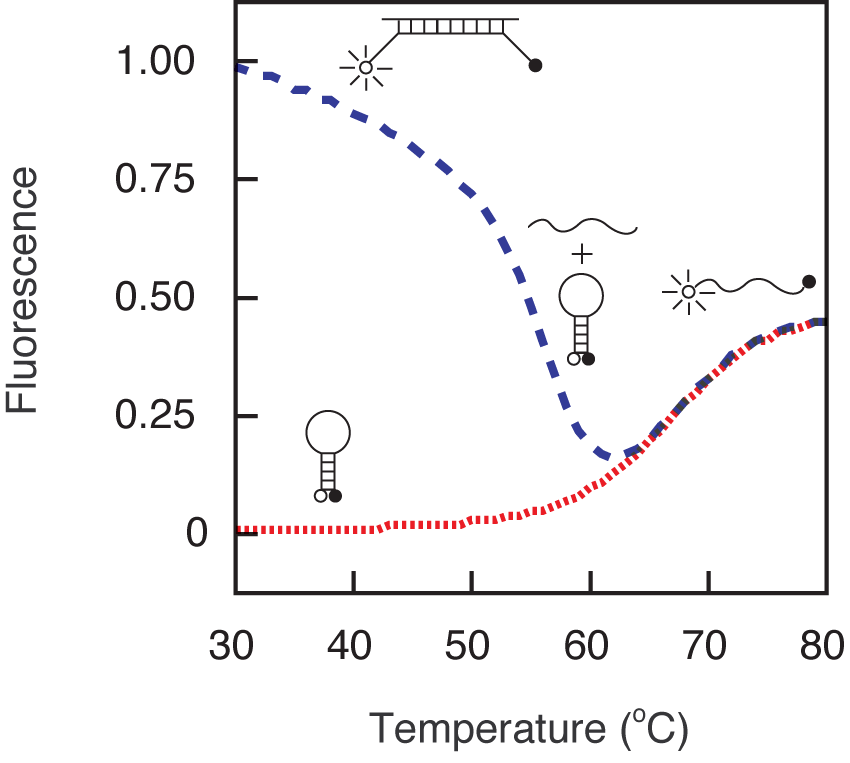
Figure 2. Thermal denaturation profiles of a molecular beacon (red-dotted line) and the hybrid formed between the molecular beacons and its oligonucleotide target (blue-dashed line). The profiles indicate that this molecular beacon can be used below 55 °C.

2. Real-time monitoring of polymerase chain reactions
Utilize molecular beacons that are complementary to a sequence in the middle of the expected amplicon. The length of their arm sequences should be chosen so that a stem is formed at the annealing temperature of the polymerase chain reaction. The length of the loop sequence should be chosen so that the probe-target hybrid is stable at the annealing temperature. Whether a molecular beacon actually exhibits these design features is determined by obtaining thermal denaturation profiles, as detailed in the previous section. Molecular beacons with appropriate thermal denaturation characteristics are included in each reaction at a concentration similar to the concentration of the primers. During the denaturation step, the molecular beacons assume a random-coil configuration and fluoresce. As the temperature is lowered to allow annealing of the primers, stem hybrids form rapidly, preventing fluorescence. However, at the annealing temperature, molecular beacons also bind to the amplicons, undergo conformational reaorganization, and generate fluorescence. When the temperature is raised to allow primer extension, the molecular beacons dissociate from their targets and do not interfere with polymerization. A new hybridization takes place in the annealing step of every cycle, and the intensity of the resulting fluorescence indicates the amount of accumulated amplicon. In the procedure below, the synthesis of an 84-nucleotide-long amplicon is monitored with the same molecular beacon whose synthesis and characterization was described in previous section.
2.1. Procedure
- Set up six 50 µl reactions so that each contains a different number of targets (1,000,000; 100,000; 10,000; 1,000; 100; 10; 1 copies),
0.34 µM molecular beacon, 1 µM of each primer, 2.5 units of Amplitaq Gold DNA
polymerase (Perkin Elmer), 0.25 mM of each deoxyribonucleotide, 3.5 mM MgCl2,
50 mM KCl, and 10 mM Tris-HCl, pH 8.0.
- Program the spectrofluorometric thermal cycler to incubate the tubes at 95 °C for 10 min to activate the Amplitaq Gold DNA polymerase, followed by 40 cycles of 30 sec at 95 °C, 60 sec at 50 °C, and 30 sec at 72 °C. Monitor fluorescence during the 50 °C annealing steps.
2.2. Results
Figure 3 shows the level of fluorescence as a function of the number of temperature cycles completed.
The level of fluorescence is proportional to the amount of amplicons present in each cycle. The
reaction that did not contain any template, did not show any rise in fluorescence. The number of temperature
cycles required before the fluorescence signal becomes detectable over the background is inversely
proportional to the logarithm of the initial number of template molecules. This
relationship is true over a wide range of template concentrations.
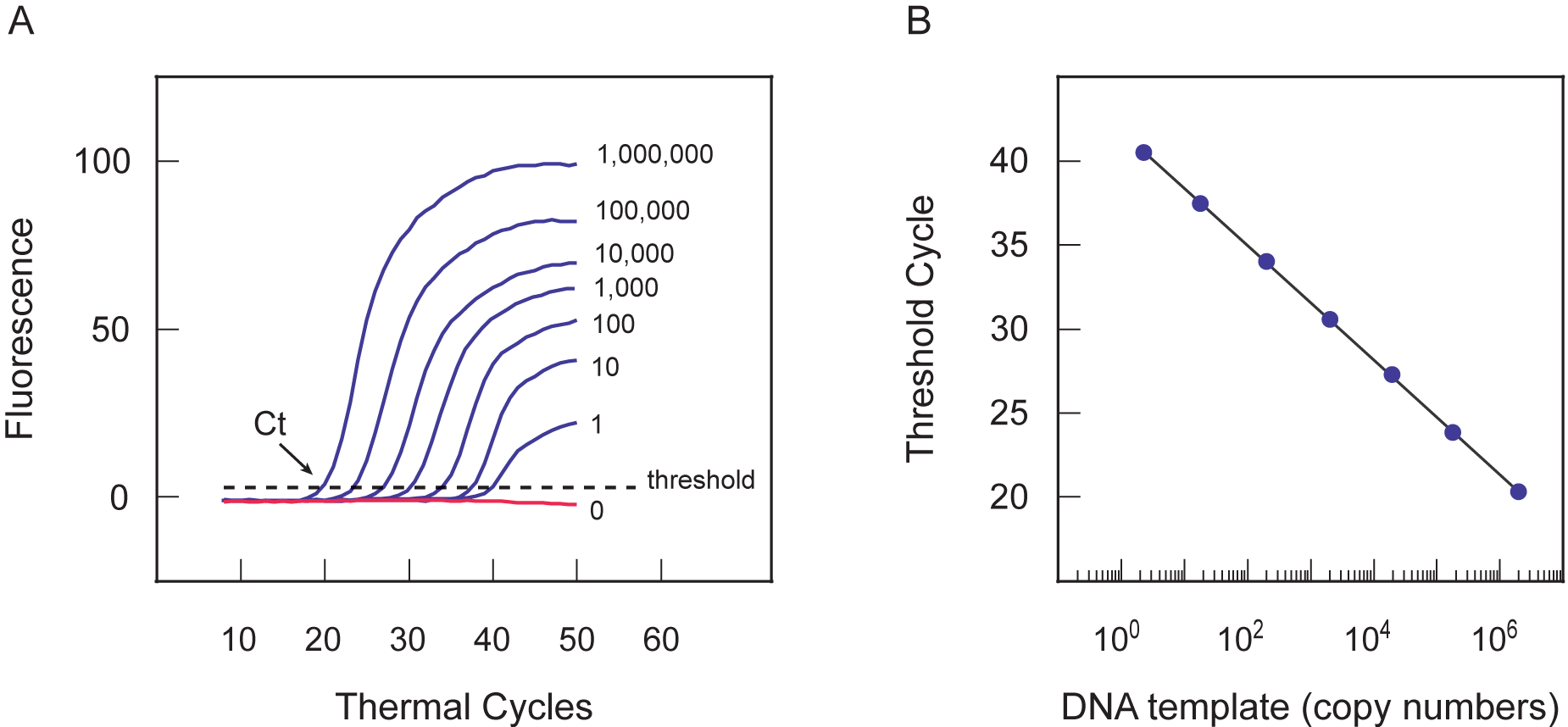
Figure 3. (A) The threshold cycle (Ct) is the cycle at which the fluorescence rises significantly above the background. The fluorescence increases as the molecular beacons bind to the amplification products that accumulate during each successive cycle. In the early cycles of amplification, the change in fluorescence is usually undetectable, but at some point during amplification, the accumulation of amplified DNA results in a detectable change in the fluorescence of the reaction mixture. The threshold cycle number decreases as the number of target molecules initially present in a reaction increases. (B) The standard curve can be used to determine the starting amount of an unknown template, based on its threshold cycle. Given known starting amounts of the target, a standard curve can be constructed by plotting the log of the starting amount versus the threshold cycle. The threshold cycle is inversely proportional to the logarithm of the number of target molecules initially present.
3. Literature
Detailed descriptions on the design, synthesis and application of molecular beacons appeared in:
- Tyagi S, Marras SAE, Vet JAM, and Kramer FR (2000) Molecular beacons: hybridization probes for detection of nucleic acids in homogeneous solutions. In Kessler C (ed.), Nonradioactive Analysis of Biomolecules, second edition. Springer Verlag, Berlin, Germany, pp. 606-616.
- Marras SAE, Kramer FR, and Tyagi S (2003) Genotyping SNPs with molecular beacons. Methods in Molecular Biology 212: 111-128. PMID: 12491906: PubMed Link
- Vet JA and Marras SAE (2005) Design and optimization of molecular beacon real-time polymerase chain reaction assays. Methods in Molecular Biology 288: 273-290. PMID: 15333910: PubMed Link
Recent Publications from our group
Pawar S, Xue HH, Wang S, Marras SAE, and Xue C (2026) A SuperSelective primer-based real-time PCR platform for hypersensitive detection of azole resistance in Cryptococcus neoformans. Microbiology Spectrum: e0116626. PMID: 42808770: PubMed Link
Vargas DY and Kramer FR (2026) SuperSelective PCR primers for determining cis/trans configurations of mutations within the same gene. PLoS One 21: e0349389. PMID: 42149869: PubMed Link